
Table of Contents
- Why Getting Your Ring Size Right When Shopping Online
- How to Measure Ring Size With String or Paper at Home
- Using a Printable Ring Size Chart and Conversion Chart
- What Is the Average Ring Size for Women?
- Does Ring Size Change With Temperature and Time of Day?
- Knuckle Size, Band Width, and Other Factors That Affect Fit
- Common Ring Size Mistakes to Avoid (and What to Do Between Sizes)
- Frequently Asked Questions
Last Updated: September 15, 2026
Why Getting Your Ring Size Right When Shopping Online
Learning how to find ring size online solves the biggest obstacle to buying jewelry without trying it on. With a paper strip, a ruler, and ten quiet minutes, you can land on a size you trust.
Online shopping removes the fitting room, so accuracy has to come from you. A ring that slides off gets lost; one that pinches stays uncomfortable all day. Because most retailers build to standard sizing, your at-home measurement translates directly to the size you order.
How to Measure Ring Size With String or Paper at Home
The string and paper strip method is the most reliable way to measure ring size at home because it captures your finger's true circumference. You need paper or non-stretchy string, a pen, and a millimeter ruler. Avoid yarn or elastic, which stretch and skew the result.
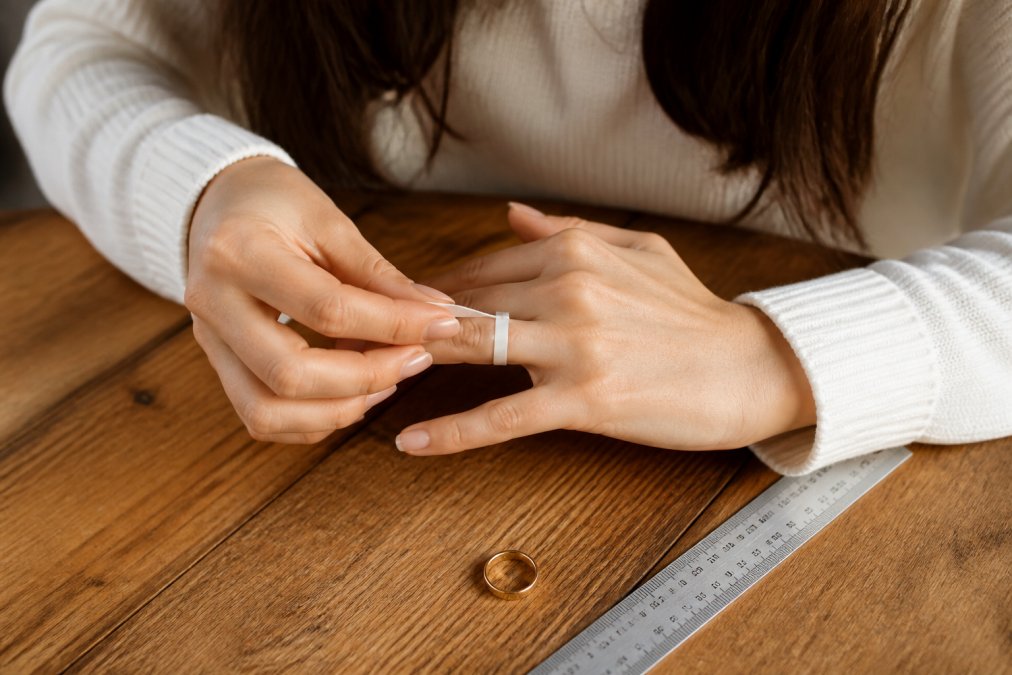
Step-by-Step: The String and Paper Strip Method
- Wrap the paper strip or string around the base of your finger, just below the knuckle.
- Pull it snug, not tight. The strip should sit against the skin without pressing into it.
- Mark the exact point where the strip overlaps itself with your pen.
- Lay the strip flat against a ruler and measure the distance in millimeters. This is your circumference.
- Match that number to a ring size chart, or divide the circumference by 3.14 to find the diameter.
Repeat two or three times; if numbers differ by more than a millimeter, average and round up.
How to Measure Using a Ring You Already Own
If you own a ring that fits the intended finger well, skip the string. Measure its inside edge in millimeters, that's the diameter. Multiply by 3.14 for circumference, then check both against a size chart.
A common mistake is measuring the outside of the band, which includes metal thickness and reads larger than your true size. Measure only the inside edge, and for wide bands allow extra room, since they sit tighter than thin ones at the same listed size.
Using a Printable Ring Size Chart and Conversion Chart
A printable ring size chart turns your millimeter measurement into an orderable size, and a conversion chart handles the rest. Printable PDFs only work at 100% scale, if "fit to page" or "shrink to fit" is on, every size shrinks and your result is wrong.
Verify Your Print Before You Trust It
Most charts include a calibration line along one edge.
Reading US, UK, EU, and JP Sizes on a Conversion Chart
| System | How It's Expressed | Example |
|---|---|---|
| US size | Whole and half numbers | 6, 6.5, 7 |
| UK size | Letters | L, M, N |
| EU size | Whole numbers, larger scale | 52, 54, 56 |
| JP size | Numbers, distinct scale | 11, 12, 13 |
Why the Same Number Means Different Things at Different Retailers
National Institute of Standards and Technology handbook on weights and measures
When a Printable Chart Beats a String
A printable chart is better when sizing an existing ring rather than a bare finger, when you want a second opinion on a string measurement, or when buying for someone else and you can borrow one of their rings.
What Is the Average Ring Size for Women?
Does Ring Size Change With Temperature and Time of Day?
Yes, ring size changes with temperature and time of day, often enough to move you half a size.
The Seasonal Swelling Problem Most Guides Skip
A practical way to handle it:
- Measuring in cold weather? Add roughly a quarter size before ordering, or measure in a warm room after ten minutes of rest.
- Measuring in hot weather? Your number is likely your largest. Order to it for a year-round fit; size down a quarter for a snugger winter fit and accept summer may feel tight.
- With real seasonal swings, the safest single number is your warm-weather measurement: a slightly loose winter ring can be tightened with a sizing bead, while a too-tight summer ring can't be worn at all.
Time of Day, Exercise, and Other Temporary Swelling
Beyond seasons, everyday triggers move your finger size measurably:
- Time of day. Late afternoon and evening are largest; early morning smallest.
- Exercise. A workout or long walk swells fingers for an hour or more.
- Heat exposure. A hot shower, hot car, or direct sun expands the finger temporarily.
- Salt and hydration. A salty meal or mild dehydration shifts fluid balance within hours.
- Altitude and travel. Altitude and humidity changes affect swelling, relevant if you measure at home but the ring will be worn in a very different climate.
How to Plan Around Swelling Instead of Fighting It
- Comfort fit bands. The inside is gently rounded, so it glides over the knuckle and feels less binding at the base than a flat band. It doesn't change your size, but makes a slightly loose ring more wearable.
- Sizing beads or an adjustable shank. Sizing beads or an adjustable shank can be used to take up cold-month slack, or to fit an adjustable shank that opens and closes.
A Simple Rule for Seasonal Buyers
If you can only measure once, do it in the late afternoon in a comfortable room, and add a quarter size if that day is cold.
Knuckle Size, Band Width, and Other Factors That Affect Fit
Accessibility matters too. Anyone with low vision or limited hand dexterity can struggle with a slipping paper strip. A ring mandrel, a large-scale printable chart, or a virtual sizer with clear zoom controls all help, and asking a friend to mark the overlap removes the trickiest step.
Common Ring Size Mistakes to Avoid (and What to Do Between Sizes)
| Mistake | Why It Happens | The Fix |
|---|---|---|
| Measuring a cold finger | Fingers shrink in cold | Measure at room temperature |
| Using stretchy string | Yarn and elastic give | Use paper or non-stretch string |
| Measuring the outside of a band | Metal thickness inflates it | Measure the inside edge only |
| Sizing only the base | Knuckle gets ignored | Measure knuckle and base, size to the larger |
| Forgetting band width | Wide bands fit tighter | Go up a quarter size for wide bands |
Frequently Asked Questions
Can I measure my ring size online without any tools?
You can use a virtual ring sizer on a retailer's site, but you must calibrate your screen first with a credit card or ruler so the on-screen circle matches real measurements. Phone-based sizers work the same way. For the most reliable result, combine a virtual sizer with a physical method like a paper strip or an existing ring measured against a printable chart, then compare the two numbers.
What is the most reliable way to find my ring size at home?
Measuring an existing ring that already fits well gives the most consistent result. Place it over a printable ring size chart and match the inside edge to the closest circle. If you don't have a ring that fits, wrap a paper strip around your finger, mark where it overlaps, and measure the length in millimeters against a conversion chart. Measure two or three times at different hours to confirm.
Does ring size change with temperature throughout the day?
Yes. Fingers swell in warm conditions and shrink in cold ones, so a ring that fits snugly in the morning may feel tight after an afternoon outdoors in summer. Measure at room temperature, ideally in the late afternoon or evening when your fingers are at their average size. If you are between sizes, choose the larger one for wider bands and the smaller one for thin bands.
What should I do if I am between two ring sizes?
Choose based on band width and the finger you plan to wear it on. Wider bands, usually 6 millimeters or more, fit tighter because they cover more of the finger, so size up. Thin bands under 3 millimeters can go with the smaller size. The base of your finger, not the knuckle, should determine the fit, but if your knuckle is noticeably wider, size for the knuckle so the ring can pass over it.