
Table of Contents
- Why Sustainable Everyday Jewelry for Women Is Worth the Investment
- Quick Comparison: Our Top Picks at a Glance
- How to Identify Sustainable Jewelry: A 5-Point Verification Framework
- Best Ethical Jewelry Brands 2026: What Sets the Leaders Apart
-
The 7 Best Sustainable Everyday Jewelry Pieces for Women
- 1. Gold Chain Necklace Collection: The Layering Staple
- 2. Gold Cloud Earrings: Lightweight Luxury for Daily Wear
- 3. Chunky Town Striped Cuff Bangle: Bold Without the Weight
- 4. Chunky Town Pavé-Trim Cushion Ring: Nickel-Free and Built to Last
- 5. Lux Necklace (36-Inch): 14K Gold Filled for Longevity
- 6. Dragonfly Necklace: Tanzanite and London Blue Topaz
- 7. Lion and Horse Necklaces: 14K Gold Vermeil with Diamonds
- Greenwashing vs. Real Impact: How to Tell the Difference
- Caring for Your Sustainable Jewelry So It Lasts a Lifetime
- Conclusion: Building a Collection That Aligns With Your Values
- Frequently Asked Questions
Last Updated: September 16, 2026
Why Sustainable Everyday Jewelry for Women Is Worth the Investment
Sustainable everyday jewelry for women is jewelry designed for daily wear that minimizes environmental harm through recycled metals, ethically sourced stones, and transparent supply chains. The global sustainable jewelry market is valued at approximately $75.55 billion in 2026, according to Business Research Insights market analysis, with projections reaching $126.31 billion by 2035.
Quick Comparison: Our Top Picks at a Glance
The table below summarizes the seven pieces covered in this guide, with materials and price points.
| Piece | Material | Price | Best For |
|---|---|---|---|
| Gold Chain Necklace Collection | 14K gold filled | $193.29 | Layering |
| Gold Cloud Earrings | 14K solid gold | $1,185.96 | Lightweight daily wear |
| Chunky Town Striped Cuff Bangle | Brass, 18K gold or rhodium | $214.33 | Statement styling |
| Chunky Town Pavé-Trim Cushion Ring | Brass, nickel-free plating | $214.33 | Everyday color |
| Lux Necklace (36-Inch) | 14K gold filled | $557.01 | Longline elegance |
| Dragonfly Necklace | 14K gold, tanzanite, topaz | $1,088.97 | Meaningful gifting |
| Lion and Horse Necklaces | 14K gold vermeil, diamonds | $334.33 | Symbolic daily wear |
How to Identify Sustainable Jewelry: A 5-Point Verification Framework
Learning how to identify sustainable jewelry starts with demanding evidence rather than accepting labels. A 2024 study in MDPI's Sustainability Journal documented how recycled materials and renewable biomaterials reduce environmental impact in jewelry production, but only when brands can verify their sourcing.

Use this checklist before buying:
- Look for a hallmark or certification stamp on the metal
- Ask what percentage of the material is recycled, not just "recycled"
- Request the country of origin for stones and metals
- Confirm whether the brand publishes a supplier list
- Check for third-party audits rather than self-reported claims
Check Certifications and Hallmarks
A hallmark is a stamped mark verifying a metal's purity and origin. In the United States, sterling silver is legally defined as 92.5% pure silver, and reputable sellers stamp pieces accordingly. A sterling silver listing with no mark is a red flag.
Verify Recycled Content Claims
Recycled gold and silver should come with documentation, not just a tagline. Ask whether the brand refines its own scrap or buys certified recycled stock; vague answers usually mean vague sourcing.
Ask About Supply Chain Transparency
Supply chain transparency means a brand can name where its metals and stones originate. Traceability matters most for gemstones, where mining conditions vary widely. A brand that can't answer basic sourcing questions hasn't earned your trust.
Best Ethical Jewelry Brands 2026: What Sets the Leaders Apart
The best ethical jewelry brands in 2026 share three traits: verifiable material sourcing, durable construction, and honest communication about trade-offs. Lab-grown diamonds now hold a 56.8% share of the market, according to Lia Atelier's 2026 trend report, which tells you buyers are rewarding transparency over tradition.
The 7 Best Sustainable Everyday Jewelry Pieces for Women
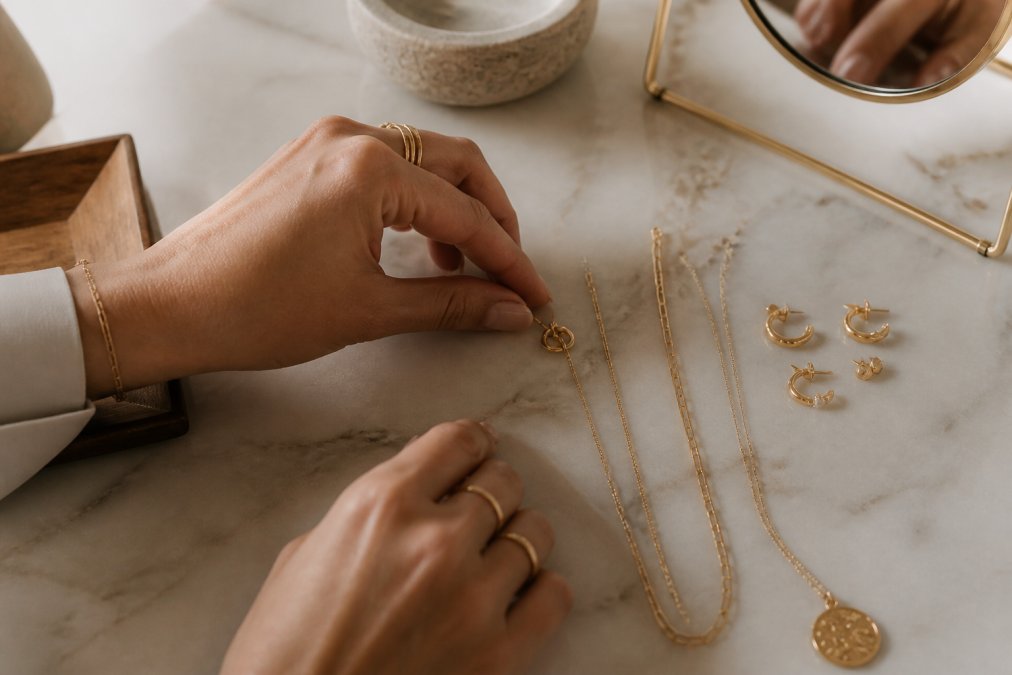
1. Gold Chain Necklace Collection: The Layering Staple
The Gold Chain Necklace Collection is the workhorse of a daily rotation. Made from 14K solid yellow gold filled in 2.5mm or 3.2mm widths, it resists tarnishing and handles heat and water far better than plated alternatives.
2. Gold Cloud Earrings: Lightweight Luxury for Daily Wear
At 6 grams per earring and 25mm long, the Gold Cloud Earrings sit comfortably through full workdays without pulling on the lobe. They're crafted from 14k solid gold with a secure friction back closure.

Priced at $1,185.96.
3. Chunky Town Striped Cuff Bangle: Bold Without the Weight
The Chunky Town Striped Cuff Bangle uses an open-top design that adjusts to your wrist, set with Amazonite stones and pink enamel over a solid brass base finished in 18k gold or rhodium.
It costs $214.33.
4. Chunky Town Pavé-Trim Cushion Ring: Nickel-Free and Built to Last
If sensitive skin has ruled out rings before, this one is worth attention. The Chunky Town Pavé-Trim Cushion Ring is nickel-free and lead-free, built on hand-finished brass with a turquoise dome and gold or rhodium plating, in four sizes.
Priced at $214.33.
5. Lux Necklace (36-Inch): 14K Gold Filled for Longevity
The Lux Necklace is a 36-inch sequins chain in 14k gold filled with a matching clasp. Gold filled construction uses more than double the gold of plated chains, which is why it holds up to daily wear.

It's priced at $557.01.
6. Dragonfly Necklace: Tanzanite and London Blue Topaz
The Dragonfly Necklace pairs 14k yellow gold with natural tanzanite and London blue topaz. At 45 grams it has real presence, and the dragonfly motif carries meaning for buyers drawn to transition or growth.
It costs $1,088.97.
7. Lion and Horse Necklaces: 14K Gold Vermeil with Diamonds
Both the Lion Necklace and Horse Necklace are crafted from 14K gold vermeil over sterling silver with diamond accents, measuring 16mm x 17mm on an 18-inch chain. Designed in a New York City workshop, they're built for daily wear.
Stunning 14K Solid Yellow Gold Filled →
Each is priced at $334.33.
Greenwashing vs. Real Impact: How to Tell the Difference
Greenwashing is marketing a product as environmentally responsible without verifiable evidence. It thrives in jewelry because the terms buyers trust most, "eco-friendly," "green," "conscious," "natural", carry no legal definition, so a brand can print any of them without changing a single sourcing practice.
The Five Claims That Usually Fall Apart Under Scrutiny
Most greenwashing hides behind a small set of phrases. Here's how each breaks down when you push for evidence:
- "Eco-friendly" or "green." No defined meaning. Ask what specifically is eco-friendly, the metal, the stone, the packaging, the shipping, and what changed versus a conventional version.
- "Recycled" without a percentage. Recycled content can range from a trace to the entire piece. Ask for the percentage by weight and whether it applies to the metal, the stones, or both.
- "Ethically sourced" with no named origin. This phrase is only as strong as the supply chain behind it. A brand that can't name the country or refiner hasn't demonstrated anything.
- "Conflict-free" as a standalone badge. For diamonds, the relevant framework is the Kimberley Process, which governs rough diamond trade but addresses conflict financing rather than broader labor or environmental conditions. "Conflict-free" is a floor, not a ceiling.
- "Carbon neutral" via offsets. Offsets can be legitimate, but they don't reduce emissions from mining virgin metal. Ask whether the brand measured its footprint before buying credits.
What Verifiable Impact Actually Looks Like
Three signals separate real programs from marketing:
- Specific numbers. "Made from 100% recycled silver" beats "eco-conscious" every time. Percentages are falsifiable; adjectives aren't.
- Named suppliers and refiners. A published supplier list signals confidence in sourcing; treating the supply chain as a trade secret asks you to take the brand's word.
- Third-party audits and certifications. Self-reported claims are the weakest evidence. Look for outside audits and check whether the certification body publishes its standards.
Carbon footprint is the hardest claim to verify. Mining virgin metals is energy-intensive, so recycled gold and silver avoid a meaningful share of that impact, but the exact figure depends on the metal, refinery, and energy mix. If a brand won't discuss its footprint, treat the claim as unproven rather than disproven.
A Quick Red-Flag Checklist
- The sustainability claim appears only in marketing copy, never on the product page
- No percentage is given for recycled content
- No country of origin for stones or metals
- No named certification or auditor
- The brand has no repair, take-back, or recycling program
- "Carbon neutral" appears with no methodology or baseline year
If a brand clears most of these, the claim is probably substantive. If it fails several, the label is doing more work than the supply chain.
Caring for Your Sustainable Jewelry So It Lasts a Lifetime
Durable materials still need routine care for a decade of wear. But care is only half the story: the other half is repairability and what happens to a piece when you stop wearing it, the part most guides skip.
Routine Care by Material
Different constructions need different handling; the wrong habit can shorten a piece's life faster than daily wear.
- Gold filled and vermeil. Wipe with a soft, dry cloth after each wear to remove skin oils, sunscreen, and perfume residue. Avoid abrasive polishes, which wear through the gold layer. Store separately so the surface doesn't rub against harder metals.
- Solid gold. The most forgiving option. Warm water, mild dish soap, and a soft brush handle most buildup. Pat dry to avoid water spots.
- Sterling silver. Tarnishes with air and sulfur exposure. Store in an anti-tarnish pouch or sealed bag with a tarnish strip. Wear it often, skin oils actually slow tarnish on silver.
- Brass with plating. The plating is the wear layer. Keep it away from chlorine, ammonia, and harsh cleaners, and remove before swimming or showering.
- Stones. Tanzanite, topaz, turquoise, and opal are softer than diamond and can scratch or fade. Keep them out of ultrasonic cleaners unless a jeweler confirms it's safe.
A few habits extend lifespan across all materials:
- Remove rings before gardening, gym sessions, or dishwashing
- Apply perfume and lotion before putting jewelry on, not after
- Store chains flat or hanging to prevent kinks
- Keep pieces separate so stones don't scratch each other
- Wipe down after travel, when pieces pick up the most grime
Repairability: The Most Overlooked Sustainability Metric
A piece you can repair is a piece you don't replace, making repairability one of the most practical, and least discussed, sustainability features in everyday jewelry.
What to look for before you buy:
- Replaceable clasps. A standard lobster clasp can be swapped by any jeweler for a few dollars. A sealed or proprietary closure may require sending the piece back to the maker, or scrapping it.
- Serviceable prongs and settings. Prongs wear down and stones loosen; a jeweler should be able to retip or rebuild a prong without remaking the whole piece.
- Standard sizing. Rings resizable up or down a size or two stay wearable through weight changes and finger swelling. Full-eternity bands and some channel-set designs often can't be resized.
- Accessible findings. Jump rings, ear wires, and chain links in standard gauges are easy to source and replace.
End-of-Life: Closing the Loop
Most guides stop at buying, but the sustainability loop only closes when a piece leaves your collection responsibly. Three options worth asking about before you buy:
- Brand take-back and recycling programs. Some jewelers accept old pieces, their own or others', and route the metal into refining. Ask whether the program is free, whether it accepts any brand, and what happens to the recovered metal.
- Trade-in and credit. A growing number of brands offer credit toward a new purchase when you send back an old piece, keeping metal in circulation and giving you a reason to upgrade rather than accumulate.
- Independent refining and resale. Precious metal refiners buy scrap gold and silver by weight, and resale platforms let you pass pieces to a new owner. Both extend the material's useful life.
A Simple Annual Routine
Once a year, have clasps and prongs checked by a jeweler, clean each piece according to its material, and review what you haven't worn in twelve months. Pieces that no longer fit your rotation are candidates for trade-in, resale, or recycling, not the back of a drawer.
Conclusion: Building a Collection That Aligns With Your Values
The hard part isn't finding sustainable everyday jewelry for women. It's finding pieces you'll actually wear past the first month. A collection built around a few durable, versatile pieces beats a drawer full of trend buys every time.
Frequently Asked Questions
How can I tell if jewelry is ethically sourced?
Look for third-party certifications like Fairmined or SCS Global Services, which verify responsible mining and recycled content claims. Check whether the brand discloses its supply chain, including where metals and gemstones originate. Hallmarks on precious metals, such as a .925 stamp for sterling silver or a 14K mark for gold, confirm material quality. If a brand cannot answer basic questions about its sourcing, treat that as a red flag. Verifiable sourcing means the brand can name its suppliers and show documentation.
Why choose recycled gold and silver for everyday jewelry?
Recycled gold and silver reduce the demand for newly mined metals, which lowers the environmental impact of extraction. They perform identically to virgin metals in terms of durability and appearance. The sustainable jewelry market is projected to reach $61.75 billion by 2032, and consumer preference for recycled materials is a primary driver. Choosing recycled metals also supports the circular economy by keeping existing precious metals in use rather than in landfills.
What certifications should I look for in sustainable jewelry?
Fairmined certification confirms gold comes from responsible artisanal and small-scale mines that meet ethical labor and environmental standards. SCS Global Services certifies recycled content claims. For diamonds, look for Kimberley Process compliance to confirm they are conflict-free. The Responsible Jewellery Council provides broader supply chain certification covering human rights, labor practices, and environmental impact. A brand that holds at least one of these certifications has undergone independent verification, which is far more reliable than self-reported claims.
What are some affordable eco-friendly jewelry options?
Gold filled and gold vermeil pieces offer the look of solid gold at a lower price point while maintaining durability. For example, a 14K gold filled chain necklace starts around $193, and a brass-based cuff bangle with 18K gold plating is approximately $214. These materials resist tarnishing better than standard plating and are safe for sensitive skin. Sterling silver is another affordable option that works well for everyday wear and can be recycled at end of life.
How do I know the sizing will be right when buying jewelry online?
Measure your wrist, finger, or neck with a soft tape measure before ordering. Most online jewelers provide size charts with exact measurements in millimeters or inches. For rings, measure the inner diameter of a ring you already own that fits well. For necklaces, consider where you want the pendant to sit: 16 inches typically falls at the collarbone, while 18 inches rests just below it. Brands that offer free exchanges reduce the risk of ordering the wrong size.
What is the best jewelry to wear every day?
Pieces made from durable materials like 14K gold filled, 14K gold vermeil, and solid sterling silver hold up best to daily wear. Minimalist designs such as slim chains, simple hoops, and delicate pendants work with most outfits and resist looking dated. Avoid pieces with thin plating or glued-in stones, which tend to wear out quickly. The key is choosing materials that resist tarnishing and designs you can layer or wear alone without worrying about damage.